
On this page
- What to do when you feel breathless
- Understanding breathlessness
- Breathing techniques and comfortable positions
- Managing anxiety and relaxation techniques
- Managing low energy and staying active
- Making everyday activities easier
- Watch our breathlessness video
- How St Margaret’s can help
- Download our breathlessness guides
What to do when you feel breathless
If you start to feel breathless, there are simple things you can try to help you feel calmer and more comfortable.
10 things that may help
- Find a comfortable position: sit or stand somewhere you can support your arms and relax your shoulders
- Have cool air on your face: open a window or use a fan
- Take small sips of cold water: a mint or lozenge may also help your throat feel clearer
- Breathe gently: try relaxed, gentle breaths. If in doubt, sigh out
- Find something calming: listen to relaxing music, watch television or try a relaxation exercise
- Wear loose clothing: avoid anything tight around your chest or waist
- Relax your shoulders and neck: a gentle massage may be helpful, perhaps using appropriate aromatherapy oil
- Use the ‘calming hand’ technique: this may help if you’re feeling anxious or panicky
- Take your time when moving: try matching your breathing to your steps when walking or climbing stairs. Avoid holding your breath
- Let your muscles breathe with you: try to let your body move naturally with your breathing rather than tensing against it.
Different techniques work for different people. You may find some more helpful than others.
Practising when you feel comfortable can make these techniques easier to use when you’re breathless.
Understanding breathlessness
Breathlessness, also called shortness of breath, is the feeling that breathing is more difficult than usual or that you cannot get enough air.
It can be caused by different illnesses and conditions. It can also be affected by how you breathe, how you feel emotionally and how active you are.
Understanding what happens when you feel breathless can help you find ways to manage it.
How do our lungs work?
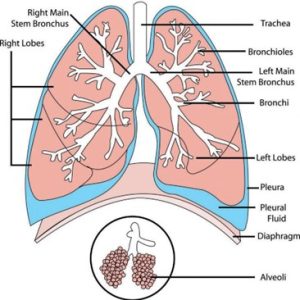
Oxygen is a gas in the air that our bodies need to work properly. Our lungs help us take in oxygen when we breathe.
We have two lungs, one on each side of the chest, with the heart between them. Inside the lungs are lots of tiny tubes that carry air into small air sacs called alveoli.
When we breathe in, air travels through our nose or mouth, down into the lungs and into these tiny air sacs. Oxygen then passes into the bloodstream through tiny blood vessels called capillaries.
At the same time, carbon dioxide (CO₂), a waste gas produced by the body, passes from the blood into the lungs and leaves the body when we breathe out.
Below the lungs is a large muscle called the diaphragm. This is the main muscle we use to breathe. It moves down when we breathe in and relaxes upwards when we breathe out, helping air move in and out of the lungs.
We breathe in and out thousands of times each day, usually without even thinking about it.
However, if our lungs are affected by illness or damage, breathing can become more difficult and cause breathlessness.
Natural responses to breathlessness
Here are some common responses and why they happen.
We normally use our diaphragm and lower chest muscles to breathe. When we’re very active or breathless, we may also use the muscles in our shoulders and upper chest.
These muscles can help with breathing during heavy exercise, but they may become tired and tense if used for long periods. This makes breathing harder work and can increase the feeling of breathlessness.
When you feel breathless, you may start taking quick, shallow breaths.
Breathing this way uses more energy and make it harder to get air into the deeper parts of your lungs, where oxygen passes into your bloodstream.
When you’re short of breath, it’s natural to try to take a big, deep breath in.
However, focusing too much on breathing in can mean you don’t give yourself enough time to breathe out fully.
Think of it like trying to refill a jug before you’ve emptied it.
Breathlessness can be frightening. You might feel anxious, frustrated, angry or even panicked.
These feelings are a normal response to something that feels uncomfortable or threatening. However, they can also make you breathe faster and cause your muscles to tense, which may increase breathlessness.
Remember, you’re not alone in feeling this way. Many people living with breathlessness experience similar emotions, and understanding why they happen can help you feel more in control.
How breathing, emotions and activity are connected
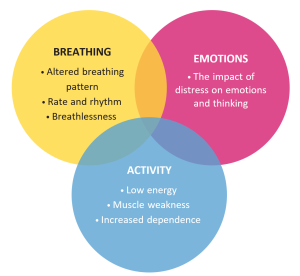
Breathlessness isn’t just a physical experience. Your breathing, emotions and activity levels can all affect one another.
For example, feeling breathless may make you anxious. Anxiety can make your breathing faster, which can increase the feeling of breathlessness.
You may also start avoiding activities that make you breathless. Over time, this can weaken your muscles and make everyday activities more difficult.
Learning ways to manage your breathing, emotions and activity levels can help break this cycle.
Breathing techniques and comfortable positions
Finding a comfortable position and practising gentle breathing may help you feel more in control when you’re breathless.
Find a comfortable position
Changing your position can help your breathing muscles work more comfortably.
Try to find a position that supports your shoulders, relaxes your upper chest and gives your diaphragm room to move.
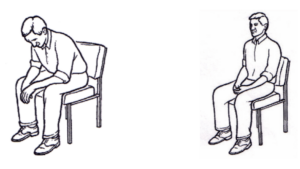
Sitting down
Sit on a chair and lean forwards slightly, resting your arms on your thighs. Relax your shoulders and wrists.
Alternatively, sit back comfortably with your arms resting on your thighs with your palms facing upwards.
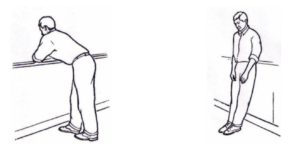 Standing up
Lean forwards with your arms supported on a sturdy surface such as a worktop or windowsill.
You may also find it helpful to lean back against a wall with your shoulders relaxed and your arms resting by your sides. Keep your feet slightly apart and around 30cm from the wall.
Practise gentle breathing
Try to breathe gently and comfortably rather than forcing yourself to take deep breaths.
- Find a comfortable position and relax your shoulders. Place your hand on your tummy just below your ribs
- Gently sigh out, allowing the tummy to shrink
- ‘Allow’ the next breath in naturally, feeling your tummy expand slightly, like a balloon
- Focus on where the breathing is happening, feeling it around the waist. You can watch the movement in the mirror or put a light object on your tummy and watch how it moves, if you need help
- As you breathe out, imagine gently blowing on a candle flame to make it flicker. Try to breathe out twice as long as you breathe in
- Sigh out, pause, then allow the air in.
Practising this technique when you’re relaxed can help you become familiar with it, making it easier to use when you’re breathless.
Managing anxiety and relaxation techniques
Feeling breathless can be frightening. Many people tell us they experience fear, anxiety, frustration or a sense of panic when they’re short of breath.
These feelings can cause your muscles to tense and your breathing to become faster, making breathlessness feel worse.
Learning ways to relax can help you feel calmer and more in control.
Practising relaxation
Relaxation is a skill that becomes easier with practice. If possible, try setting aside 20–30 minutes each day.
- Find somewhere quiet and make yourself comfortable
- Close your eyes if this helps you relax
- Listen to calming music if you enjoy it
- Breathe gently at your own pace, without forcing your breathing
- As you breathe out, allow your shoulders to drop
- Imagine the muscles in your body gradually relaxing
- Picture somewhere peaceful where you feel comfortable and safe.
There is no single right way to relax. Try different approaches and find what works best for you.
The ‘Calming Hand’ technique
The calming hand is a simple exercise you can use when breathlessness makes you feel worried or panicky.
Rest your left hand in your lap or on the arm of a chair, with your palm facing upwards.
Starting with your thumb, gently hold each finger in turn.
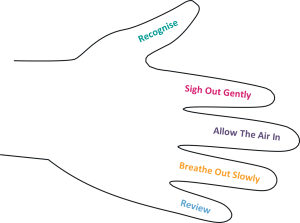 Thumb – Recognise
Notice the signs that you’re becoming anxious or panicky. Remind yourself to use the calming hand technique.
First finger – Breathe out
Gently sigh out and allow your neck and shoulder muscles to relax.
Second finger – Breathe in
Allow the air to come in naturally, feeling your breathing around your waist.
Ring finger – Slow down
Breathe out gently, trying to make your breath out slightly longer than your breath in.
Little finger – Review
Notice whether you’re beginning to feel more in control.
If you feel calmer, gently stretch your fingers until you notice some tension in your arms. Then stop, let your hand drop and allow your shoulders to relax.
If you’re still feeling anxious, repeat the exercise from the beginning.
You’re not alone
Many people living with breathlessness share similar worries and experiences.
Some people have described it like this:
“If I could just control these attacks of breathlessness I’d be OK.”
“I feel like I can do things but then I try and I lose my energy.”
“I am not sad. I just feel down – breathing does that to you.”
Knowing that others experience similar feelings can be reassuring. Talking about your worries with someone you trust or a healthcare professional may also help.
Managing low energy and staying active
Living with breathlessness can leave you feeling tired and low in energy.
You may find that activities you once enjoyed now feel more difficult, or that you need to rest more often.
Finding a balance between rest and gentle activity can help you maintain your strength, confidence and independence.
Understanding the cycle of breathlessness and inactivity
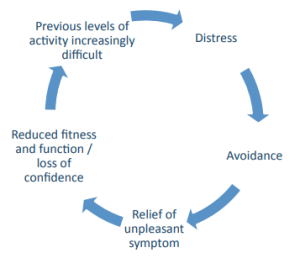 When an activity makes you breathless, it’s natural to want to avoid doing it again.
Although avoiding activity may bring short-term relief, doing less over time can cause your muscles to become weaker.
This is called deconditioning.
Deconditioning often affects the leg muscles, making it harder to stand up from a chair, climb stairs or walk comfortably.
As your muscles become weaker, everyday activities can require more effort and leave you feeling more breathless or tired.
The good news is that muscles can often regain strength through regular, manageable activity.
Recognising habits that may make things harder
When you’re breathless, you may naturally change how you move to make things feel easier.
For example, you might:
- Rush to finish an activity before becoming breathless
- Pull yourself up the stairs using the banister rather than relying on your legs
- Push strongly through your arms when standing from a chair
- Drop quickly into a chair rather than lowering yourself slowly
- Only walk for exercise, avoiding other movements that feel difficult
- Keep going until you’re exhausted rather than taking regular breaks
Although they may give short-term relief, these behaviours may lead to long-term negative effects. Challenging them may be of benefit.
Planning and pacing your activities
Planning your day can help you manage your energy and make time for the things that matter most to you.
Think of your breathing capacity as a bank balance, with each activity having its own breathing cost. The aim is to stay in credit, finding a balance between being active whilst not becoming too short of breath or running out of energy.
Try to spread activities throughout the day and take regular breaks. Asking family or friends to help with everyday chores can save your energy for the things you enjoy.
It may take some trial and error to find out what works best for you.
Feeling tired and needing to rest throughout the day is normal. Give yourself time to rest, but try to balance periods of rest with some gentle exercise, as prolonged rest can result in a rapid drain of energy, weak muscles and feelings of overwhelming tiredness.
Start small and build up gradually. Set yourself small, achievable goals and increase your activity as you feel able. You could work towards a total of 30 minutes of activity spread throughout the day.
Building up your activity
Here is an example of an excercise and activity programme to help you maintain your strength and confidence.
- seated and standing exercises – 5 mins
- a walk outside – 10 mins
- stepping up and down on stairs – 5 mins
- housework or workshop – 5 mins
- seated and standing exercises – 5 mins
Total = 30 mins
Some people have a time of day when they feel particularly tired or breathless. Avoid activity at this time. Enjoy a book, the television or a nap instead.
Making everyday activities easier
Try matching your breathing to your steps. For example, breathe in for one step and out for the next two steps. You can also try breathing in for two steps and out for three.
Choose a rhythm that feels comfortable – getting this right may take practice.
Doing this will help you walk or climb stairs at a steady pace, without having to stop to catch your breath. It may also reduce the time you need to recover once you have reached the top. Many people talk of ‘listening to their body’ or ‘taking things very slowly’ as helpful ways of finding the right pace for them.
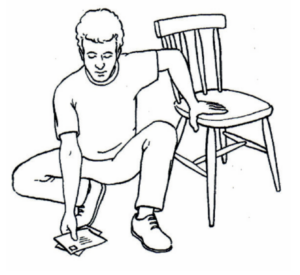 Bending forwards from the waist can make breathing more difficult.
Instead, ease yourself into a crouching position, keeping your back straight and bending from the knees rather than from the waist.
This allows you to keep your chest upright and your shoulders back, to help you continue to breathe as comfortably as possible.
As you ease yourself into this position ensure you have something secure to hold onto such as a table or chair. This will provide extra support and give you something to push against as you stand up.
Having something to lean back against once in that position is helpful.
If you need to work at a level below your waist, such as emptying the washing machine or a cupboard, or gardening, use a low stool and sit, rather than bend.
Lifting heavy items such as wet laundry or shopping bags can cause you to become tired or short of breath quickly. Try placing the washing on a stool next to the clothesline.
Do not carry bags with your arms by your sides, as the effect of heavy bags dragging your arms down restricts breathing and you can become breathless. Use a wheeled shopping trolley instead, ask family or friends to help, or use home delivery.
Keep things you use regularly somewhere easy to reach, without bending or stretching. Wall cupboards at a comfortable height may be more convenient than low cupboards or drawers. Organising your home to reduce unnecessary movement can help you save energy for other activities.
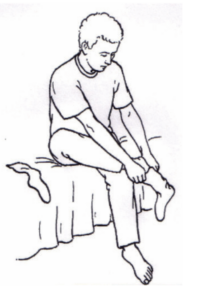 Sit for as much time as possible while dressing and use abdominal or tummy breathing throughout.
Try to wear loose fitting clothes especially around the waist and chest. Avoid bending over to put on socks, tights, shoes etc.
Rushing to answer the phone before someone hangs up or standing to talk can make your breathlessness more noticeable. Try to make sure that family, friends or work colleagues know that it can take time to answer the phone. Ask them to let the phone ring for longer so you don’t have to rush to it. Make sure you are sitting down comfortably before picking up the phone and take a moment to ‘catch your breath’ before starting your conversation.
If you find you become breathless while talking on the phone or in conversation, talk slowly, use short sentences and pause after each sentence to take a relaxed breath.
Showering, bathing and dressing can be exhausting and bathrooms can feel claustrophobic which will increase the feeling of breathlessness. When the weather allows, opening a window slightly may help to reduce shortness of breath.
Tips that help to make bathing or taking a shower easier:
- as you undress, resist the temptation of holding your breath as you pull clothes over your body. Take your arms out first, then quickly slip it over your head. So your face is covered as little as possible and you don’t have to raise your arms for long
- not filling the bath too full and not having the water too hot
- once you are undressed, sit at the side of the bath and slowly lift one leg in at a time rather than swinging both legs in together
- ask an Occupational Therapist (OT) for advice about aids that would make things easier for you
- use the breathing exercises before lowering yourself into the Sitting in the shower may be less tiring
- position the shower to avoid water spraying directly onto your face
- let the water out of the bath before you get You may find it easier to lift yourself onto your knees first and rest before you stand
- while you sit at the side of the bath, wrap a large towel around yourself so that you begin to dry. This reduces the effort of patting yourself dry. A towelling dressing gown can do the drying for you instead
- sit when you dry yourself, bring your feet up to prevent bending over to dry your feet and legs
- rest as frequently as you need.
And remember to use lower chest breathing.
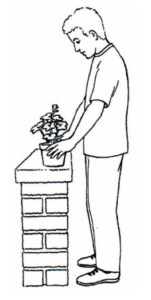 Being breathless can make gardening difficult. Problems range from continually bending down, to not being able to get up after sitting to plant bulbs or to weed. A low garden chair placed alongside borders or flowerbeds may help you to weed or prune without having to bend over, and make it more comfortable.
Rest if you feel you need to.
If these positions aren’t helpful, plant flowers in pots or trays positioned at waist level when working with them.
Do a little at a time so that you don’t become exhausted.
Remember to use tummy breathing during activities such as gardening. You will find that you can do more before becoming breathless.
A healthy diet helps to keep you feeling well, although this may seem hard to believe when you have lost your appetite.
It can be frustrating and upsetting when you cannot eat a favourite meal or snack, or join family or friends for meals. Talking and finding ways to overcome the difficulties can help with you and your family’s concerns.
Taste changes can play a part in reducing appetite.
These tips may help:
If food tastes bitter
- eat white meat, fish, eggs, milk and cheese instead of red meat, tomatoes and chocolate
- try sweet flavoured drinks, fizzy drinks and ice-lollies – these may be more palatable than tea, coffee or sour juices
- add herbs and spices to your meals as these can help to conceal bitter tastes
If food tastes too sweet
- cook with sour juices, herbs, vinegar, spices or mint.
If food has no taste at all try
- adding lots of seasoning and sugar to meals and eating food at room temperature.
Mealtimes – remember little and often!
- small helpings of enjoyable meals or snacks may helps you get more pleasure from food and result in you eating more than attempting large meals
- sipping a small glass of sherry before food can help stimulate appetite
- pain can suppress appetite. If you have pain take painkillers regularly. If you have occasional pain a tablet half an hour before eating can help reduce its impact on your appetite
- if being breathless makes eating difficult, eating slowly and taking small mouthfuls of food makes it easier to chew and swallow
- include plenty of fluid in your diet. Avoid fluids that have low calories, for example juice, tea or These will fill you up without adding to your energy intake
- high calorie and protein supplements can be added to food and drink, or drunk on their own, and are a good way of boosting energy intake
- some supplements are available on prescription g. Fortsip, Maxijul or Ensure. Others can be bought over the counter in most chemists e.g. Complan or Build-up
- if they are too sweet or bland supplements can be mixed with other ingredients. Try mixing a sachet with a pint of full-fat milk and a portion of ice cream. Whisk together and keep in the fridge. This will keep for up to 24 hours. Sip two or three glasses a day. Ice cubes are an alternative: if ice cream is too sweet; try mixing a sachet with a tin of soup or in stew, add a spoonful of cream just before you serve
- drink them hot or cold, rather than at room temperature
- avoid drinking too much fluid before you eat a meal as this will reduce your appetite
- if you enjoy full fat milk, chocolate, cheese or butter have some! Although you sit and rest more than usual, your body is working to full capacity fighting your illness, responding to treatments and medications, and the extra calories will come in useful
- include plenty of fruit and vegetables in your diet. Combine them with protein supplements mentioned above or they can be eaten with cream, butter etc.
In control for what matters
Learning to be in control of your breathing, your emotions and your physical activities can lead to an improved quality of life. It is worth taking the time to think about what matters to you – these are the things that are worth the effort when working on achieving them.
The principle of small gains
When you make small differences and achievements, these are added together; their total has the potential to improve quality of life.
You may be able to achieve this by:
- controlling your breathing rate and rhythm
- becoming oxygen and energy efficient
- controlling your thinking and emotions
- knowing you are not alone in experiencing distressing breathlessness and low energy
- retaining or regaining physical fitness
- retaining or regaining independence
- learning to relax and enjoy life.
Watch our breathlessness video
This video shares practical tips and techniques you can try at home to help you manage your breathing and feel more comfortable.
Please note: This video was recorded during the COVID-19 pandemic. Some references may reflect the circumstances at that time.
*Higginson IJ, Maddocks M, Bayly J, Brighton LJ, Hutchinson A, Booth S, Ogden M, Farquhar M. on behalf of the NIHR Applied Research Collaborative Palliative and End of Life Care Theme. April 3rd 2020. Managing your breathlessness at home during the corona virus (COVID-19) outbreak.
How St Margaret’s can help
Our Breathlessness Service
If you have a life-limiting illness and would like support with managing breathlessness and low energy, our Breathlessness Service may be able to help.
Our team can work with you to understand how your symptoms affect your everyday life and find practical ways to help you feel more comfortable, confident and independent.
What support is available?
A member of our Breathlessness Management Team will talk to you about:
- Your symptoms of breathlessness and low energy
- How your symptoms affect your daily life and independence
- The activities and goals that matter most to you
- Breathing techniques, relaxation and ways to manage anxiety
- Practical ways to manage your energy and stay active
The service usually offers between one and three sessions, lasting approximately one hour each, depending on your needs.
Support is available through our Taunton and Yeovil Hospice Hubs. Home visits may be available if you’re unable to leave your home.
How to access the service
Your GP, consultant, specialist nurse or another healthcare professional can refer you to St Margaret’.
They will need to tell us:
- How your breathlessness affects you and causes distress
- What you would like to achieve
- Which other healthcare teams are involved, or have previously been involved, in managing your breathlessness
If you think this support could help, speak to your healthcare professional about a referral.